AI Agents Explained: What They Are and How SMEs Can Use Them
AI agents are autonomous software systems that perform tasks with minimal human intervention. Learn what AI agents are, how they differ from traditional automation, and exactly how SMEs can deploy them to scale without proportional hiring.
3/18/20266 min read
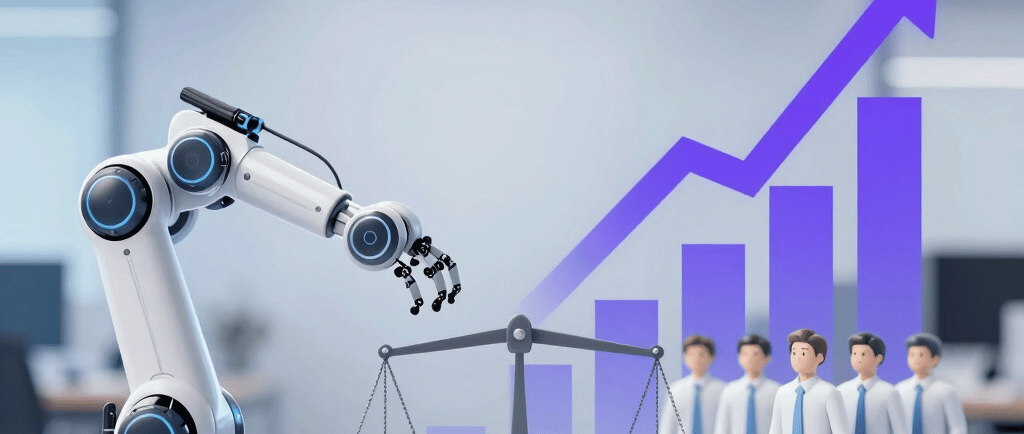
AI agents are autonomous software systems that perform tasks and make decisions with minimal human intervention, using AI to understand goals and adapt their approach. Unlike traditional automation that follows fixed rules, AI agents learn from their environment and can handle complex, varied situations—making them transformative for small businesses looking to scale without proportional hiring.
The shift toward autonomous AI agents represents a fundamental change in how SMEs can compete with larger organizations. In 2026, we're seeing AI agents move from experimental technology to practical business tools that SME founders can actually deploy today.
What Are AI Agents and How Do They Work?
AI agents are software systems that can independently plan, execute, and adapt their actions to accomplish goals. They combine three capabilities: perception (understanding what's happening), reasoning (deciding what to do), and action (executing tasks and learning from results).
Traditional automation is like a flowchart—if condition A happens, do B. AI agents work differently. They use large language models to understand what you're trying to achieve, break that goal into steps, adjust when obstacles appear, and keep improving. Think of traditional automation as a vending machine. An AI agent is more like a helpful employee who understands your business, asks clarifying questions, and gets better at the job over time.
Key characteristics: Autonomy (decisions without constant oversight), Adaptability (handles varied situations), Learning (improves through feedback), Goal-orientation (works toward objectives independently), and Integration (connects with your existing tools and systems).
What Is the Difference Between AI Automation and AI Agents?
AI automation executes predefined rules and workflows, while AI agents understand context and make adaptive decisions to achieve goals with minimal human direction. Both are valuable, but they solve different problems—and many SMEs benefit from using both.
AI Automation (Rule-Based) follows a set sequence like "When email arrives with keyword X, do Y." It's predictable and reliable for repetitive tasks like auto-tagging emails, invoice routing, and appointment scheduling. Cost: $50–$500/month. What it can't do: handle unexpected situations or truly new scenarios.
AI Agents (Adaptive) understand goals and figure out how to achieve them. They handle novel situations, make judgment calls, and get better over time. Examples: customer support, lead qualification, financial analysis. Cost: $500–$2,500/month.
Most real-world implementations mix both—rule-based automation routes leads to your AI agent, which then qualifies them intelligently. For SMEs: automation frees humans from repetitive tasks, but AI agents free humans from decisions.
Can Small Businesses Actually Use AI Agents?
Yes. 2026 is the first year where AI agents are genuinely practical for most SMEs without custom development or large budgets. Platforms like Claude, ChatGPT API integrations, and no-code AI platforms make deployment accessible without engineering. Instead of $50,000+ custom builds, you're looking at $50–$2,500/month. And there are now 18+ months of SME case studies showing what works.
Consider AI agents if: you have complex or variable work, your team spends time on decision-making, you need to scale output without proportionally scaling headcount, you have 5+ people in your company, and you have $500–$2,000/month budget for tools.
What Can AI Agents Do for an SME?
AI agents can handle customer-facing decisions, internal operations, and analytical work. Common use cases: Customer Service (60–70% fewer tickets to humans), Lead Qualification (40–50% faster sales cycle), Financial Analysis (30–40% time reduction), HR Processes (50+ hours saved per hire), and Email Management (10–15 hours weekly saved).
According to McKinsey research, organizations implementing AI agents see 30–50% time savings in affected workflows. For an SME: a customer service person handles 50+ queries daily vs. 30–40 without an agent, finance work drops from 20 hours weekly to 12–14 hours, and recruiting cuts from 100 hours per hire to 50.
How Much Do AI Agents Cost for a Small Business?
AI agent costs for SMEs range from $50–$2,500/month. Most SMEs implementing their first agent spend $500–$1,500/month.
Entry Level ($50–$300/month): Simple agents handling one specific task, minimal integration. Example: An accounting firm using an AI agent to draft client communications.
Mid-Tier ($500–$1,200/month): Handles 2–3 interconnected workflows, integration with your CRM or email. Example: A service business using agents for lead qualification and customer support.
Enterprise-Level ($1,500–$2,500+/month): Multiple specialized agents, deep integration with your full tech stack, custom training on your data.
Hidden costs to budget for: Integration time ($1,000–$5,000 one-time), Training and adoption (4–8 hours), and Ongoing optimization (2–4 hours monthly). 73% of businesses see positive ROI within 90–120 days of AI implementation.
How Do You Get Started with AI Agents?
Start by identifying one high-impact, low-risk task and iterate from there. Most SMEs have a functional first agent within 2–3 weeks.
Step 1 (Week 1): Identify your first use case. Look for a task where someone spends 10+ hours weekly, it requires judgment, and you can capture examples of how it should be done. Ask your team: "What's something you do repeatedly that requires thinking but isn't truly creative work?" Common first use cases: customer support, lead qualification, expense review, email management.
Step 2 (Week 1): Map the current process. Document what information is received, what decisions are made, what tools are used, and what output is produced. Gather 10–20 examples of good work—the more examples you provide, the faster agents learn your preferences.
Step 3 (Week 2): Choose your platform. No-code platforms (Zapier, Make, n8n) work best for automating workflows across existing tools. API-based platforms (OpenAI, Anthropic) offer more flexibility. For most SMEs, starting with an API-based platform through no-code tools is the sweet spot.
Step 4 (Weeks 2–3): Build and test. Set up your agent with 3–5 example scenarios, test it with real work, gather feedback on accuracy and edge cases, and iterate on the agent's instructions.
Step 5 (Week 4+): Deploy and measure. Track time saved, error rate, team satisfaction, and impact. Refine weekly based on results.
Step 6: Scale to your next use case. Once you have one working agent, adding a second is 30–40% faster. Most SMEs go from one agent to three across different functions within 6 months.
What Will AI Agents Look Like in 2026 and Beyond?
Three major trends are shaping AI agent evolution. First, agents are becoming specialized and intelligent—your customer service agent will be trained on your specific policies and customer base, outperforming any generalist. Second, multi-agent systems are becoming normal—specialized agents collaborate, hand off work, and check each other's decisions. Third, integration is getting seamless—agents are built into your email, CRM, and accounting system, not in a separate dashboard.
Gartner predicts that 40% of enterprise applications will have AI agents by end of 2026. Learning to work with AI agents now puts you 12–24 months ahead of competitors who wait.
Frequently Asked Questions
How accurate are AI agents? Can they replace humans entirely? AI agents are 85–95% accurate on well-defined tasks. They shouldn't replace humans—they should replace tedious decision-making so humans can focus on judgment calls that matter. The goal is smarter work, not fewer workers.
Will AI agents take jobs at my company? Realistically, no—they replace time spent on tasks, not the people. Your team member goes from spending 30 hours weekly on a repetitive task to 10 hours, freeing them for higher-value work like strategy and client relationships.
What if my business is too small or too complex for AI agents? Almost all SMEs benefit from at least one agent. Even 3-person teams use agents effectively. Complexity actually makes agents more valuable—the more variation in your work, the smarter the agent needs to be.
How do I secure an AI agent if it needs access to sensitive data? Most agent platforms offer enterprise security controls. You can control what data the agent sees, use encrypted connections, and audit everything it does.
What happens if an AI agent makes a mistake? You build in human oversight at critical points. Low-risk decisions can be fully autonomous; high-risk ones need a human in the loop.
Ready to Explore AI Agents for Your Business?
You now understand what AI agents are, why they matter for SMEs, and exactly how to start. The companies winning in 2026 aren't debating whether to use AI agents—they're already deploying them.
The next step is identifying your first use case and building a simple agent to test the concept. Most SMEs we work with invest 2–3 weeks to get something working. Some of those experimental agents become core to how they operate. That's how you stay competitive.
You don't need to understand AI deeply to benefit from AI agents. You just need to start.
Modern Minds
AI automation consulting for ambitious SMEs. We help your team achieve more — freeing them from repetitive work to focus on what drives growth.
Contact
GET STARTED
info@modern-minds.ai
© 2026 Modern Minds. All rights reserved.